Master ML Model Evaluation in 5 Steps

Master ML Model Evaluation in 5 Steps

🧰

Instant Toolkit

2 artifacts

📋
Step-by-Step Guide

1

Grasp Fundamental Metrics for Classification and Regression

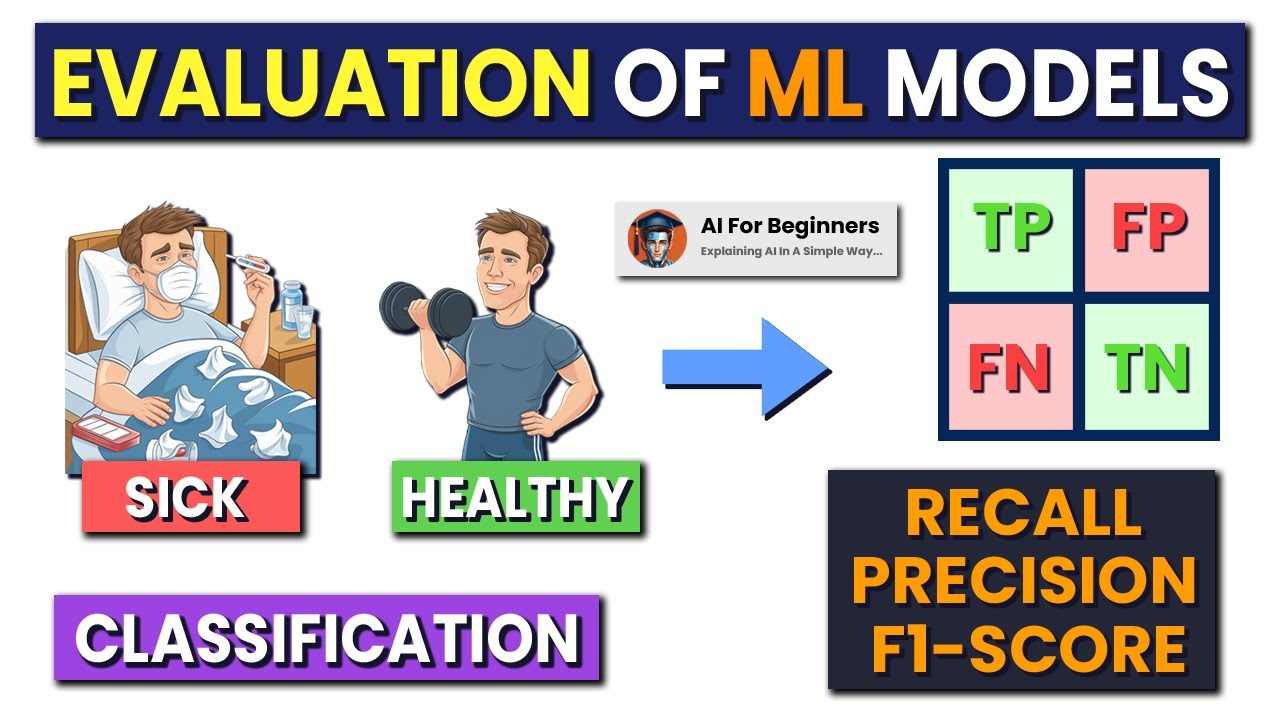
Start with basics: accuracy, precision, recall, F1 for classification; MSE, MAE, R² for regression.

Classification Example (Scikit-learn)

from sklearn.metrics import accuracy_score, precision_recall_fscore_support
y_true = [0, 1, 1, 0]
y_pred = [0, 1, 0, 0]
print(accuracy_score(y_true, y_pred))  # 0.75
precision, recall, f1, support = precision_recall_fscore_support(y_true, y_pred)
print(precision)  # [1.0, 0.5]
print(recall)     # [1.0, 0.5]
print(f1)         # [1.0, 0.5]

Regression Example

from sklearn.metrics import mean_squared_error
y_true_reg = [3, -0.5, 2, 7]
y_pred_reg = [2.5, 0.0, 2, 8]
print(mean_squared_error(y_true_reg, y_pred_reg))  # 0.375

Read Scikit-learn Metrics Docs and Google ML Guide.

Why this step matters:
  • -Builds foundation to select right metric for any task
  • -Enables informed decisions on model quality in projects
1-2 hours
Python, Jupyter Notebook, Scikit-learn
$0
Definition of Done
  • Explain precision vs recall tradeoff
  • Compute metrics manually and with code
  • Identify when accuracy fails (imbalanced data)
Common Mistakes to Avoid

Using accuracy on imbalanced datasets

Switch to F1-score or AUC-ROC

Ignoring prediction probabilities

Use log_loss or Brier score for probabilistic outputs

2

Following along, or just reading? 👀

Spin up a personalized “learn model evaluation” plan you can save, check off, and return to anytime — unlimited on the free trial.

Start free trial →
3
4
5